
 Your agency just lost another account.
They’ll tell you it was about “fit” or “timing” or “strategic direction.”
Here’s what they won’t tell you: 82% of major brands now operate in-house agencies. That number was 42% in 2008.
55% are actively planning to switch their primary agency within six months.
This isn’t clients being difficult. This is a full-scale rejection of the agency model.
Why?
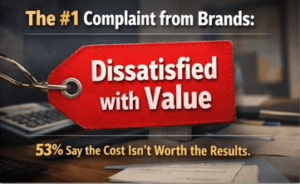
Because 53% of brands cite “dissatisfaction with value” as their number one complaint. Up from 39% last year.
Translation: We’re paying you a fortune and we don’t know what
we’re getting for it.
I’ve been on both sides of this. I’ve been the agency guy presenting to clients. And I’ve been the CMO writing the checks.
As the client, you know the dirty secret. The agency doesn’t make the
work.
They brief strategy. They concept. They present. And then they hire someone else to actually make the thing.
The production company shoots it. The post house edits it. The VFX shop handles graphics. The sound design studio does audio.
The agency coordinates all of this. For a massive fee.
Here’s the headwind agencies are facing:
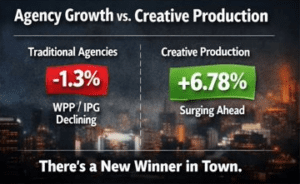
- Traditional agency model: Growing at 1.3% annually


- Creative production services: Growing at 6.78% annually
That’s not a gap. That’s a chasm.
WPP, the world’s largest agency holding company, declined 3.3% in 2024. IPG fell 3.6%. These aren’t temporary blips. This is structural collapse.
Meanwhile, brands that moved production in-house are reporting:
- 30-70% cost reductions
- 50% faster timelines
- Better creative (because production is involved from the start)
- Full control over the process
Bayer saved $10-11 million in their first six weeks of going direct. Sprint cut their time-to-market from weeks to one day (while doubling click-through rates!).
These aren’t small wins. These are game-changers.
In response, the agencies are scrambling. They’re adding production capabilities. They’re talking about “integrated offerings.” They’re promising to move faster.
But here’s the problem: You can’t bolt production onto an agency structure and expect efficiency. You’re just stacking new infrastructure on top of already bloated infrastructure.
The bureaucracy remains. The layers of account management remain. The incentive to move slowly remains.
Real transformation requires rethinking the entire model from scratch.
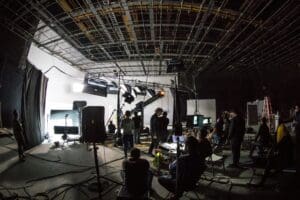
That’s what we did at Wild Gravity. Creative, production, post, VFX, sound – all under one roof. Small teams of experts who can scale fast. No account managers playing telephone. No approval layers.
Just people who make stuff.
Our first clients were trillion-dollar corporations – Amazon and Microsoft. They came to us because they were tired of the traditional model. Tired of paying for strategy they didn’t need. Tired of waiting months for work they needed in weeks. Tired of not being able to prove ROI to their CFO.
Only 27% of CMOs exceed their C-suite’s expectations. Why? Because they can’t demonstrate clear value from their marketing spend.
When you’re paying millions for an agency retainer, and you can’t point to exactly what that money produced, you’ve got a problem. Creative Production solves this. You know exactly what you’re paying for. You control the process. You own the data. You can respond in real time.
Of course, it’s not magic and requires a serious restructuring of your go-to-market infrastructure. You need the right talent. You need to streamline processes. You need to be willing to make the change.
But 82% of major brands figured it out. They made the math work.
Your agency is probably pitching you on why you need them now more than ever.
Ask them one question: “If 82% of major brands are building in-house capabilities, and creative production services are growing at double your rate, what makes your model the future?”
See what they say.
Jon Sneider helps brands break free from the agency model. His book “Hacking Advertising” became an Amazon bestseller by telling CMOs what agencies won’t.